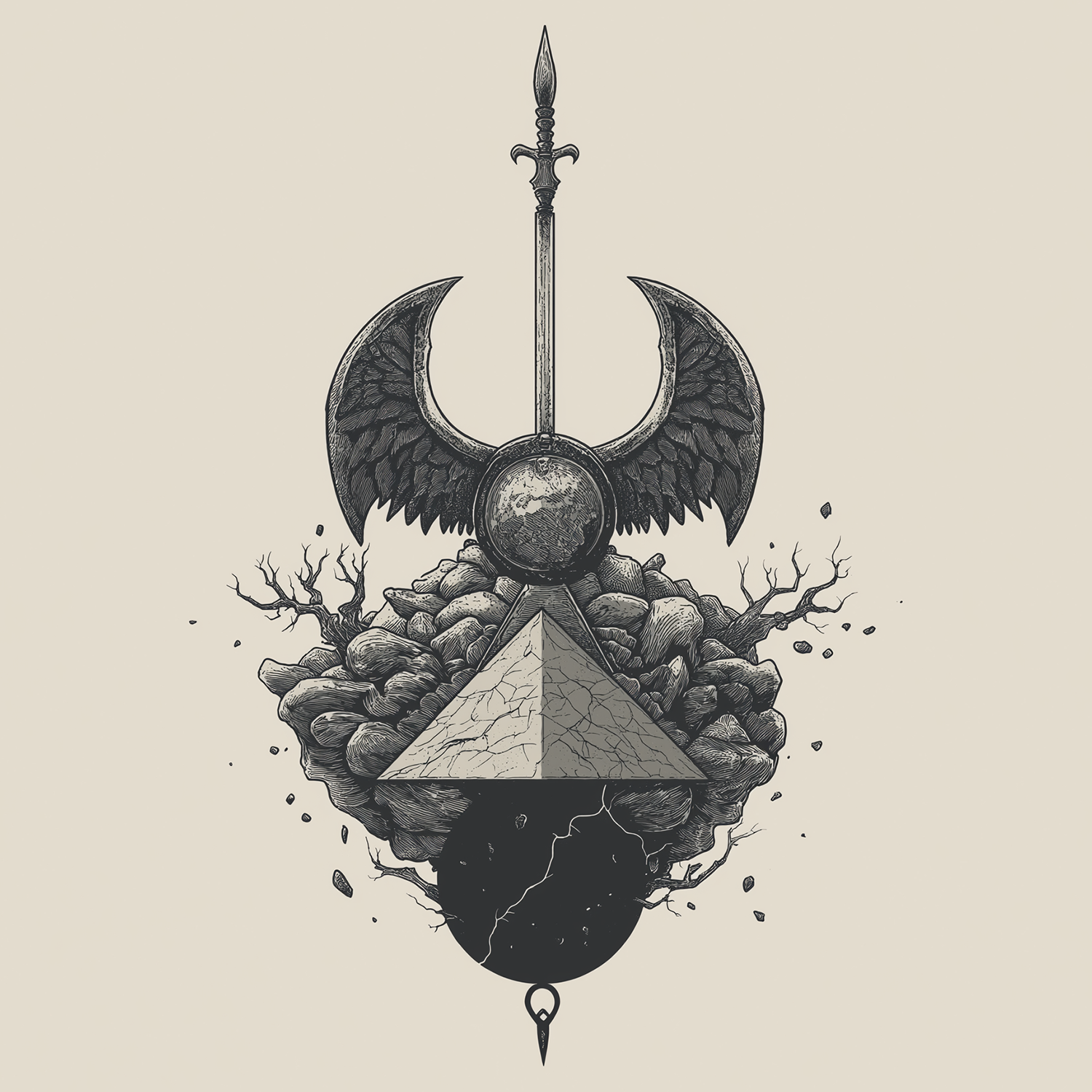
Thelean Cosmology
General Thelean cosmology states that the Primordial Gods, also known as the First Gods and the Ancients, are immortal beings who inhabited the realm known as the Garden of Dreams. It is believed that the Garden was born from the collective dream of the gods who slept upon a harmonious earth. In their dreams, the gods grew to realize they had the power to shape the world around them. They realized the power to travel throughout the heavens, leaving and returning to earth at will. And so they abandoned the confines of their garden to explore the depths of their power. Earth became the gods’ experimental playground, but over time the Ancients lost sight of their path, and the garden of the earth withered.
And so the primordial gods set out to recreate the beauty that they had lost—the mountains, valleys, waters, and skies—each god with their own intent and specialty, their own vision of beauty and worth. Wishing never to let their garden wither again, they created all manner of creatures as stewards of the earth, beings that were connected to the earth, and to each other. It is said that as their new earth began to take shape, some of the gods hoped to create beings who recognized and worshiped their power, while others among the Ancients yearned for stewards who, like them, who could craft with an ingenuity of their own with no care to celebrate those who had come before. The more the Ancients sought to recreate what the earth should be, the more their experiments grew antagonistic and competitive. Instead of a New Garden of Dreams, the playground of the gods became overpopulated, chaotic, and unable to sustain itself, destined to wither again.
Thrennum, the god of life, decided that soon there would be no space left in the world for the gods to continue to create life, and there needed to be an order to the world’s growing physical reality, and so she decided she must leave the New Garden of Dreams to discover what must be done to balance the chaos among the gods. But doing so meant that Thrennum would violate Bailiea’s decree. Bailiea, in her love for Thrennum, had once decreed one cannot have life without warmth; thus, if Thrennum chose to leave Bailiea’s side, she would be doomed never to look upon the sun’s face again. Vallicast, who harbored a possessive love for Bailiea, finally convinced Thrennum to leave, stressing that it was her duty to help life. While Thrennum was gone visiting the center of the universe, Bailiea grew bitter and lonely, and so she decided to leave earth as well to watch over Thrennum from a distance. Vallicast, too, followed behind in secret. Thrennum discovered that to save life, she needed to set all the gardens into motion, into a frame of time.
From there, the stories vary as to which gods knew about or had a hand in Thrennum’s return, Thrennum’s Chase, and Thrennum’s grand journey to set order across the face of the earth, but most holy texts seem to agree that at some point Thrennum made a pact with Usk’eche, the god of fire—a pact that scholars call the beginning of time. Usk’eche convinced Thrennum that fire could do more than provide warmth; it could also be imbued with the power to change all of Bailiea’s creations. Usk’eche insisted that Bailiea would never agree to see her creations unmade just for the hope of setting order into the earth, but that order must extend from the premise that all made must be unmade. Thrennum reluctantly agreed, but only if that change was limited with a starting and ending of combustion according to Thrennum’s clock, thus an unmaking must always find its way to making once again. Bailiea watched from a distance as this pact was made real, and became disheartened that Thrennum broke her decree only to lock her into an endless cycle according to the new order. Even as Bailiea would become subject to Thrennum’s clock, she believed that if Thrennum wished to unmake her creations, she would one day devise a plan to force Thrennum to unmake her own self according to that same clock.
The distant union of Thrennum and Usk’eche also produced a child named Maros, who was born with the powers of change, rot, decay, and death. With their new plans in place, Thrennum, Usk’eche, and Maros returned to the earth. With Maros’s singular gift to create death and Usk’eche’s newly imbued gift to create change, the gods were able to craft a timely order we now call mortality. To join the new order, all the gods became subject to Thrennum’s clock. Thrennum had found success; the creations could remain in balance so long as they each had their own time. For millions of years, Thrennum’s clock maintained peace and prosperity according to this newfound order, and the New Garden flourished. The gods continued to create life, and Thrennum roamed earth keeping a watchful eye on her clock. The only tension seemed to happen when Thrennum see Bailiea silently pass by. Thrennum would watch the light of Bailiea’s sun pass by each day with regret, even though she felt she had saved the New Garden. Bailiea continued to plot in secret against Thrennum as she roamed the skies according to the new order, Vallicast also remained in the shadows for eons plotting a way to avenge Bailiea and share in her power.
Vallicast waited patiently until Thrennum’s clock seemed to be an unchangeable reality, and in that complacency, approached Maros while Thrennum and Usk’eche slept. Vallicast shrouded death’s door in darkness and shadow, away from the light of the sun. A void fell on all creation blanketing the earth in ash. In that haze, Maros felt truly powerful, realizing that death seemed far purer when shrouded from Bailiea’s light and obscured from Thrennum’s clock. With the anonymity of Vallicast’s shadow, Maros began wielding the power of death and decay according to his own whims. Vallicast was seduced by Maros’s power and continued to follow behind losing sight of their original purpose. The union of Vallicast and Maros gave birth to Joghath, born with the power of falling and inversions. In the wake of this shadow, Maros destroyed nearly all of creation. He became so frightening in his unquenchable thirst for death that Vallicast cried tears which turned into pools of bright crystal. Finally, Vallicast fled to Bailiea, but rather than admit what they had done, Vallicast convinced Bailiea that Thrennum was responsible for Maros’s destruction, as Maros was a child of Thrennum’s clock. Bailiea rushed to cast blame on Thrennum, but when she found her, took pity on her as Thrennum had already blamed herself. She could not face the sun for shame, and so Bailiea forgave and pleaded with the god of time to turn around and embrace her, even though it would mean the end of the earth. But Thrennum did not want to see the creations of the Ancients unmade, and so she walked away from Bailiea and set out to stop Maros.
Thus, during the final Journey of the Ancients, Thrennum chased Maros and Joghath to the opposite sides of the earth. Usk’eche sent his Wyvernborn Princes across the divide to find them. And Bailiea, who wanted the journey to end, decided to preserve Thrennum’s clock and contain her defeat by twisting the earth into a hollow sphere. Inside, Bailiea believed that she would be able to hunt Maros and destroy him. She commanded the Wyvernborn to dig holes into the earth, elaborate tunnels that connect the deep halfhollows to the surface, but still they could not find Maros, who was hidden in the center of the halfhollows by Joghath’s magic. Maros continued to weave rot and death into the creations of the earth, and Thrennum began to believe all hope for life was lost. Among the halfhollows, Thrennum no longer saw the light of Bailiea at her back. It was a long night, so Thrennum pressed onward into the darkness hearing the Wyvernborn Princes make more and more tunnels. Millions of years passed as Thrennum tried to find a path from the halfhollows into Bailiea’s light, but a jealous Vallicast continued to shroud the Wyvernborn paths with shadow and darkness. Usk’eche took pity on Thrennum, and while Vallicast shadowed Bailiea’s path, Usk’eche used their fires to light a path for Thrennum to find the surface. Finally Thrennum was free, but then she looked on the face of Bailiea, and the shadows of Vallicast, and all that had transpired. Thrennum knew that this would always continue. She could not abide Bailiea’s actions, nor tolerate Vallicast’s treachery. So, with her last act on earth, Thrennum used the breadth of her powers to sever the ties between the heavens and the earth. Bailiea and Vallicast would forever watch over the sphere they had created, but from the skies, unable to create anything new. Instead, Thrennum disappeared, and some believe she spread across the earth, imbuing people with the power to create their own life, to reproduce, remake themselves in this new world. In this way, she thought, Maros could not hope to consume all of creation. Usk’eche decided to remain on the surface and await the return of the Wyvernborn princes, as a show of reconciliation to Bailiea.